Ranting about how messed up the world is, espcially Oklahoma.
Author Archives: Curtiswselby
They say not to write a blog from a tired space, but I suffer from chronic fatigue syndrome, so frankly, everything I do is from a tired space. Likely I'm not doing the greatest job of search engine optimization. But I know there are others like me. Passionate about life.
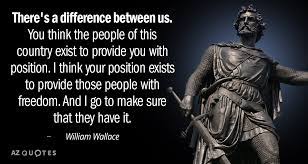
What is freedom? When you imagine it, what do you see? Hear? Feel inside? Scotland knew what it was to live without freedom. Wallace in Braveheart inspired a vision of what life could be like if they were free of the tyrannical yoke of Longshanks.
In my last post, I wrote about how Wallace challenges the status quo in Braveheart.
And challenging the world to be better is fine, but if you don’t offer a solution to the problem, if you don’t share a vision of how the world can be better, all you are really doing is whining. I doubt we would be making movies about William Wallace if all he had done was sat on his keister in a tavern and spouted about how “Back in my day we didn’t have Longshanks as king. We had Alexander III, and he couldn’t ride a horse but he was a swell king! Oh how I long for those days when kings were real men!”
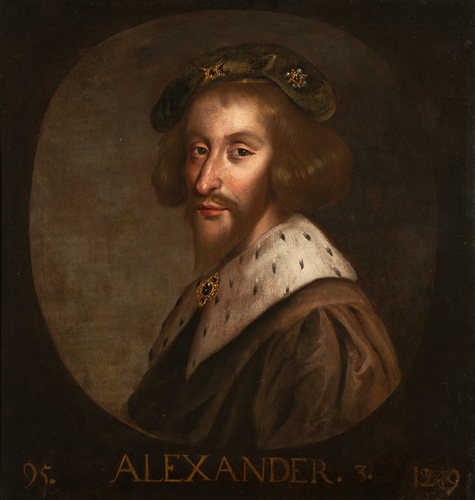
This portrait of Alexander III whose death precipitated the whole mess was painted roughly 400 years later. I have no idea if this is how he looked. He outlived his three children, and was rushing through a storm to marry a new queen when he fell and broke his neck. His granddaughter was the rightful heir, but she perished a few years later while in route to Scotland. She was only seven.
There were three ways in which Wallace shared his vision.
1) Wallace gave an inspiring speech that rallied the Scots to fight, not for the nobles, but for their own freedom.
2) In the film, Wallace sets his sights on the man he believes to be the legitimate king of Scotland, and urges this man, Robert the Bruce, to unite the clans against Edward I
3) Again in the film, Wallace takes the fight to his foe, invading and taking York, demonstrating to the Scots that they needn’t believe they were helpless against the English.
Let’s discuss these methods of influence.
The girl who would be Queen. Here we have a stained glass image of Maid Margaret, Alexander III’s granddaughter who would have been Queen of Scotland and married Longshank’s grandson had she lived. This stained glass is from Lerwick Town Hall, built in 1883. Again….no real idea what she looked like.
At the Battle of Stirling Bridge (sans bridge), Mel Gibson as William Wallace gives one of the most inspiring short speeches I can recall in cinematic history. He reminds the people that they are not fighting for the nobles, but for their own liberty. The right to marry without being forced to allow your wife to be raped. The right to safety from the oppressive occupying English soldiers. The right to be ruled by a legitimate Scottish monarch ruling from Edinburgh rather than a distant English tyrant ruling in London.
“Run and you’ll live – at least a while. And dying in your beds many years from now, would you be willing to trade all the days from this day to that for one chance, just one chance to come back here and tell our enemies that they may take our lives, but they’ll never take our freedom!”
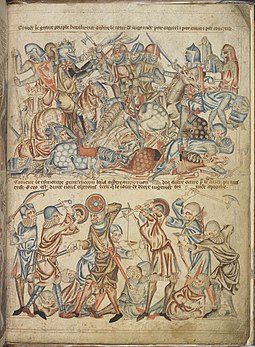
Earliest known image of the Battle of Bannockburn. The battle was in 1314. The image is from the Holkham Bible, scribed no later than 1350. This victory led eventually to the end of the war, and the independence of Scotland until a Scottish king (King James) took the throne of England in 24 March 1603.
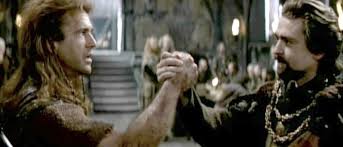
In the movie William Wallace is the seasoned veteran, and Robert the Bruce is a young man just beginning to find his way in the crazy world of Scottish politics ca 1300. He looks up to Wallace, and wants to believe the same way he does. Who can forget this scene between the two, right after Wallace has been knighted?
“
Robert the Bruce: Wait! I respect what you said, but remember that these men have lands and castles. It’s much to risk.
William: And the common man who bleeds on the battlefield, does he risk less?
Robert the Bruce: No. But from top to bottom this country has no sense of itself. Its nobles share allegiance with England. Its clans war with each other. If you make enemies on both sides of the border, you’ll end up dead.
William: We all end up dead; it’s just a question of how and why.
Robert the Bruce: I’m not a coward. I want what you want, but we need the nobles.
William: We need them?
Robert the Bruce: Aye.
William: Now tell me, what does that mean to be noble? Your title gives you claim to the throne of our country, but men don’t follow titles, they follow courage. Now, our people know you. Noble and common, they respect you. And if you would just lead them to freedom they’d follow you. And so would I.”
How we want history to look. Wallace and the Bruce banded as brothers to fight for Scottish independence.
We all know actions speak louder than words. Wallace could talk all day long, while Longshanks sent thousands of troops to slaughter the Scots. So in reality and in the film, he took the battle to the English. The movie is more based on Blind Harry’s poem than history. Since in the poem Wallace invaded York, so too in the movie he does. With great difficulty and courage, the Scots under Wallace storm the castle, behead the governor and send the head to Longshanks as a message. Ya gotta hand it to ol’ Longshanks. A lesser man would have been cowed. Instead, Longshanks plans a brilliant invasion that in both the movie and in real life, he won. Still, the message has been made. “We are not your slaves. We are to be feared. Harass us to your peril.
On Wednesday I intend to post how Wallace in the movie led by example.
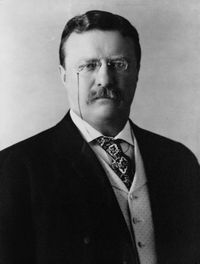
President Theodore Roosevelt, one of the masters of leading by example, was quoted as saying, “People don’t care how much you know until they know how much you care.”
To quote a Don Henley song “I will not bow down/I will not go quietly.”
Continuing the music theme borrowed from Charles Manson, The Beatles had a song: “You say you want a revolution/Well you know/We all wanna change the world”…Anyone who has studied history, even in the most cursory fashion, knows that political revolutions are often not positive things. Blood gets shed, people get hurt, and if the revolution succeeds, the government that replaced the old guard tends to be worse than, or at least no better than, the one it replaced. On the top of my head, I can only think of four successful yet positive revolutions. The American Revolution (duh!), the Bloodless Revolution of England (November 1688 to April 1689), the uprising of civil disobedience led by Gandhi in India, and the Scottish Revolution of the thirteenth and fourteenth centuries, which we have been discussing for two posts now.
Politically, this sums up to me the beauty of Braveheart. With all the inaccuracies and obvious over the top anti English bias, just this statement alone puts it head and shoulders about most movies. This is exactly what needs to be said to Washington D. C. Those who voted the first time for Trump hoped he would conduct his Presidency on this principle. Had he done so, I have no doubt he would have won again.
In this post, I’m going to model my commentary off the habits divulged in The Leadership Challenge, written by Jim Kouzes and Barry Posner. Honestly, this may end up being a multi part post. But over the course of this post or series I will relay:
1) How Wallace in the movie (and in real life) challenged the status quo.
2) How Wallace inspired a shared vision of a free Scotland.
3) How the Scots were energized to act on their own by his influence.
4) How Wallace led by example.
5) How the beaten Scotts found courage by the example he set.
This scene is so Sun Tzu. And it perfectly demonstrates what happens when a warrior is pushed against the wall. “Against…the…wall!”
The status quo in Scotland was horrific during the reign of Edward I, known as Longshanks. I’ll post a little info about him here, this and my own random knowledge will be my source for the material about Longshanks.
I’m going to start with a defense of the anti-English stance of the movie. Yes, there were mistakes in the history of the movie, but please don’t try to tell me the English were “not so bad.” If you need evidence, here is Britannica’s account of Edward’s behavior as a Prince (no, he was not yet the king).
” Civil war had now broken out between Henry and the barons, who were supported by London. Edward’s violent behavior and his quarrel with the Londoners harmed Henry’s cause. At the Battle of Lewes (May 14, 1264) his vengeful pursuit of the Londoners early in the battle contributed to Henry’s defeat. Edward surrendered and became a hostage in Montfort’s hands. He escaped at Hereford in May 1265 and took charge of the royalist forces, penned Montfort behind the River Severn, and, by lightning strategy, destroyed a large relieving army at Kenilworth (August 1). On August 4 he trapped and slew Montfort at Evesham and rescued Henry. Shattered and enfeebled, Henry allowed Edward effective control of the government, and the latter’s extreme policy of vengeance, especially against the Londoners, revived and prolonged rebel resistance.”
Henry chilled out when he was crowned king, at least when it came to his own people. But he earned “The Hammer of the Scots” as his nickname from venting his wrath on them, instead of his own people.
Britannica proceeds “Having mastered his anger, he had shown himself capable of patient negotiation, generosity, and even idealism; and he preferred the society and advice of strong counselors with good minds. As long as Burnell and Queen Eleanor lived, the better side of Edward triumphed, and the years until about 1294 were years of great achievement. Thereafter, his character deteriorated for lack of domestic comfort and independent advice. He allowed his autocratic temper full rein and devoted his failing energies to prosecution of the wars in France and against Scotland.”
This helps set up the scene. Essentially, there was a puppet Scottish king, John Balliol, who had sworn loyalty to Edward I. But the English essentially was an occupying force, and the Scottish lower and middle class were being misused. Badly.
In the movie, the Scots are invited to a negotiation, and the Scottish delegates are all found hung by William’s father, who arrives late on the scene. William’s father rallies the people to fight, but the English win, and Wallace is orphaned. His uncle takes him to raise, and teaches him Latin, French, swordsmanship. It is assumed he learns a great deal of things before he returns to his home town.
He woos the love of his life when he returns. Wins her heart. Marries her. But because of the sick medieval practice of primae noctis, they keep their marriage a secret, known only to themselves, a priest, and possibly her parents. One of the English occupation soldiers sees her, lusts for her, attempts to rape her. And she defends herself. Wallace assists, and makes his getaway, instructing her to meet him at the tree where they would meet for trysts. But she does not make it there. She is captured, and the Sheriff, to make an example of her, cuts her throat.
For Wallace, the status quo has ceased to be acceptable. Live or die, he will now bring hell down on the heads of his foes.
Primae Noctis, not to be confused with Prima Donna, was a “noble” right to spend the first night or three with any peasant bride who owed him homage. There is debate about whether this really happened, but having first heard of this in Mark Twain’s Connecticut Yankee in King Arthur’s Court, I’ve never doubted. If you think he was wrong, you may be right, but I have a site that proves it still happens, as recently as 2014, in India. I doubt Europeans from 800 years ago were much more enlightened. https://projectwhy.org/jus-primae-noctis/
As we all know (or all who have watched the movie) the rest of the film is William Wallace challenging the status quo.
This post is getting long, and it is getting late. I’ll post this, and start on the next one, hopefully publishing it next Monday.
If the status quo were this this demeaning, would you not fight? Are we certain it won’t get this bad? Are we certain it hasn’t already?
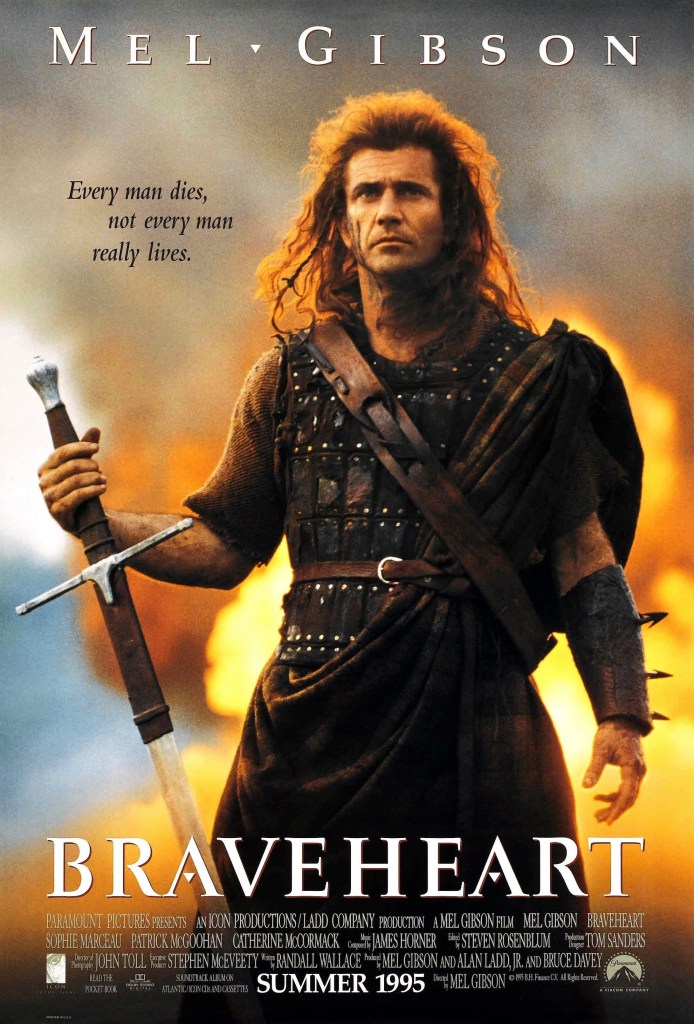
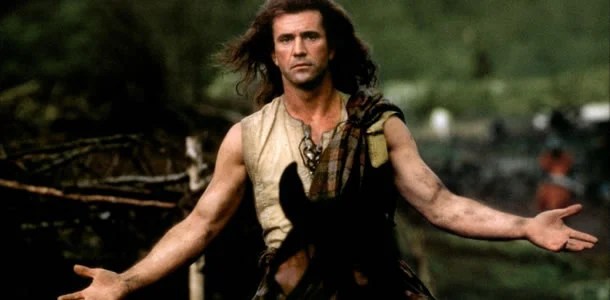
Best movie ever! I know I know, the history is bad and it is full of Brit bashing. But ya kinna unnerstan! It’s moy arland! Image from IMDB
When this came out I was 23. I was still struggling with depression, still struggling with collage, didn’t know it but was suffering periodic severe bouts of Myalgic encephalomyelitis. And I had been struggling to write a novel for about six years. I was going to call it Ironheart. It was inspired by my readings as a 17 year old. I was inspired by Man in the Iron Mask to have an incredible warrior serving a wicked king. He wins the battle for the king, only to end up dying. At the same time I was also reading Romeo and Juliet, as well as Cyrano de Bergerac. Now I look back I doubt most people could see the connections between these reads and the book I was trying to write, but it made perfect sense to me. I made cruelly slow progress. Sometimes I only wrote a few pages of month, only to rip most of them up, feeling they were worthless and derivative. Slowly the pages piled up, and I finally decided that was what I needed to knuckle down and do. This was my life work. To write Ironheart.
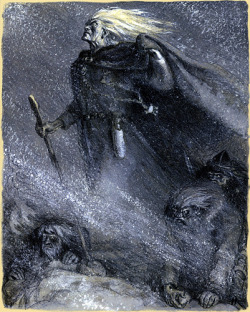
Much I would give to be an artist. Alas, I can barely draw Pac, man. But one day some years back I was working on the book (I sometimes come back to it) and there I saw. Someone had drawn a scene from my mind. My main character from the book faces a storm in one of the scenes, and in my mind’s eye, it looked almost exactly like this. I believe this is Kullervo, the anti-hero of the Finnish national epic The Kalevala. I had to do some digging to find the site again. This image is from https://www.tumbex.com/champagne-pain.tumblr/post/619068387597991936 Please take some time to visit the site, their art almost perfectly evokes the feel of the poem. And if you have ever been out in a bad blizzard, you know what the man suffers in this image. Oh well, enough of this. Back to my blog.
Anyhow, to make a short story long, I went to see Braveheart on the big screen when it came out. It was beautiful and haunting. The boy’s pain when his father and brother died, the scene where the MacClannough girl gives young Wallace a thistle. When he comes back and woos and wins her when they are both grown. Feelings stirred, memories of loves and ambitions, hopes long buried. And then…
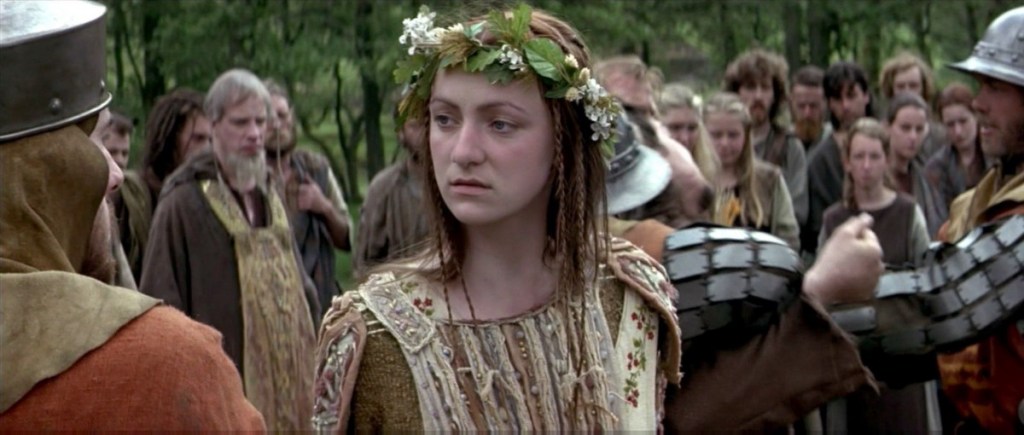
The Sheriff of Lanark, the town Wallace inhabits in the movie, slits Murron’s throat when she “assault” an English soldier who is trying to rape her. This is the pivotal scene, the point of no return of the film. Wallace changes from a peaceful farmer to an avenging warrior. In the scene where he rides up, acting as though he will surrender, the shear deadness in his eyes is almost exactly how I imagined my main character looking after something similar happens in my book.
As Mel Gibson pounds the brains of the his enemies into the dirt, I sit in awe, realizing someone already wrote my book. And did a profoundly better job at it than I would have. I fell in love with the movie, but I realized most of what I had written would have to be rewritten, or everyone would accuse me of stealing from this film.
The first thing I did after watching the film was to look William Wallace up. My encyclopedia had very little about him, just enough that I honestly felt the movie might be very accurate. The internet was a new thing back then. There was no Google yet (I can’t remember if yahoo was a thing yet or not). I did look him up but found precious little. So the wannabe historian in me was (at the time) very pleased as well.
But I would now have to drastically alter the book.
I decided I would have to go further back into the story. Write about the childhood of the protagonist, as Braveheart did. And also digging into the history of the people who became his adopted family. I actually had a rough draft when I left my ex wife.
Such a lovely act of defenestration. I know in real life I would be appalled, but watching the movie I found myself loving to hate this villain.
Next post I will discuss less personal topics. I’ll get back to leadership, and discuss the movie in the light of the book The Leadership Challenge by Jim Kouzes and Barry Posner. I’ll apply their theory that there are five practices essential for excellent leadership. Let’s hope the Tired Blogger hasn’t bitten off more than he can chew.
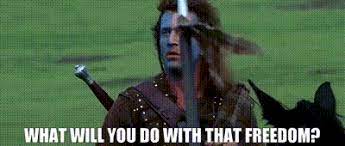
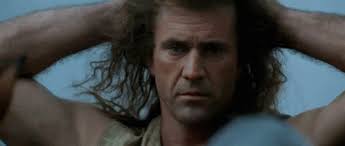
The iconic inspirational “Freedom” motivational speech of Mel Gibson’s portrayal of William Wallace. As a twenty-three-year-old, I so wanted to hear something like this. Wanted to believe that the struggle was worth it. Wanted to believe that the struggle would benefit, not the corporate hacks who run our world, but the friends and family I loved so much. So many ashes since that day. The Q Anon Shaman and the historical inaccuracies of the movie have, in some circles, discredited this work of art. But my blood still pulses when I hear it. I know I’ve failed, I believe now I will not live to see America free again. But if there was something I could do, whether by living or dying, my life would be a cheap price to pay to know my son will live in freedom.
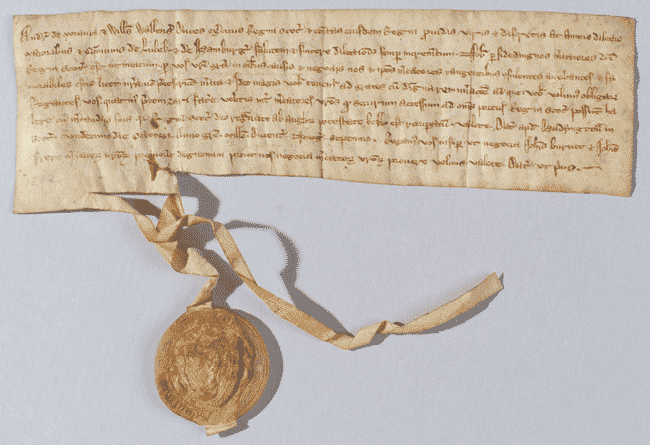
The earliest known reference to Sir William Wallace of Braveheart fame is the Lübeck letter written in 1297 with Wallace’s seal. It informs German merchants that it is safe to do business in Scotland again since the Scotts have won back their kingdom from “the power of the English.” Image from https://www.scottisharchivesforschools.org/WarsOfIndependence/LubeckLetter.asp
So I’ve been focused on gun violence, the random youtube videos I think are informative, and my last post was about how Manson displayed leadership skills. I know some won’t understand why I went down that rabbit hole, so I’ll do a better job (mayhap) on explaining this one.
I’ve thought about leadership all my life. When I was young I was big, I was energetic, and I was ambitious. This combined with my imagination and intelligence to make me seem to myself like a natural-born leader. But then something slipped. I went from being a leader in my class to being….not so much an outsider…I was loved, but the leaders were other people. People wanted me in their group (unless it was an athletic group), but they weren’t going to follow me. From that point on I wondered why. What was it that made people want to follow one person and not another? And what is it that causes people to change loyalties?
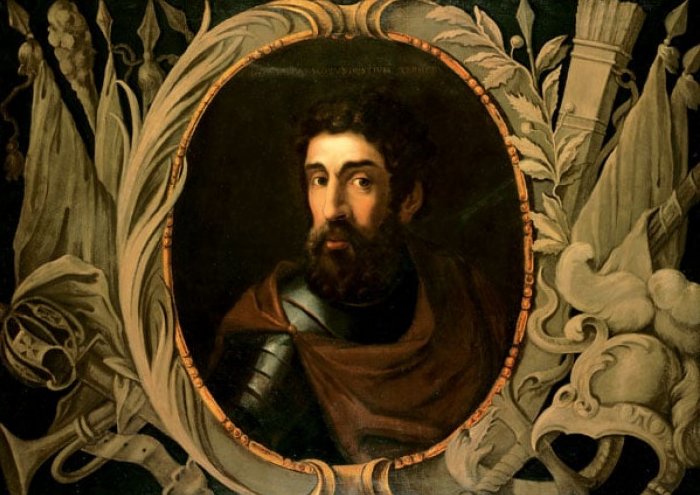
The earliest known portrait of William Wallace according to the website for the Society of William Wallace. While nowhere near as ubiquitous as Robin Hood or King Arthur, there really isn’t much known about him. This portrait is of unknown date and origin, it is speculated it may be a portrait referred to by Blind Harry in the earliest known epic poem on Wallace. Image from http://www.thesocietyofwilliamwallace.com/portrait.htm
While I don’t want to pursue this topic too deeply or scientifically here, suffice it to say that I read and think a lot about this topic. And a fair number of my favorite movies demonstrate the leadership ideas that resonate with me. And my all-time favorite movie is Braveheart.
It feels daunting, and frankly like a huge change of gears. Likely most of the success books would scream “This is not your niche!” But it’s my blog and I’ll write what I want to. Hopefully my thirty or so followers will be patient, the next few posts, possibly all the way through the rest of the month of July, I intend to devote to the movie, and to the historical William Wallace. I will in part be guided by Randall Wallace (who wrote the original novel and the screenplay of the movie) in his commentary Living the Braveheart Life, which will be one of the books I’m reading this July.
Three things I will quickly relay: first, Dante had already cast judgement on Longshanks. Second, the same year Dante’s Divine Comedy was published, the Scots had written their own “prequal” to the US Declaration of Independence. Third, William Wallace name is strangely absent from printed history from his execution till the Epic Poem The Wallace was published in 1488.
Other than official records, the first thing I can discover in print about the epic struggle for Scottish independence comes from no lesser source than Dante’s Divine Comedy. In the Paradiso, Dante states “What would the Persians say to your kings, when they see that volume opened in which all their ill deeds are recorded?” Several “Christian” kings are mentioned committing atrocious acts similar to those the Christians had condemned Pagan kings for. And on the list, we find Longshanks, a mere thirteen years after his death. “There the pride will be seen that parches, and makes the Scots and Edward’s English mad so that they cannot keep the proper borders.”
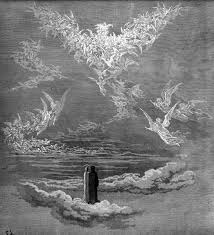
The Sixth Sphere of Heaven in the Divine Comedy, where the Just Rulers spend eternity. Their souls are knit together to form an Eagle. Who was there according to Dante? King David, Hezekiah, Emperor Constantine. King Edward I is…somewhere else…
The same year Dante finally published his masterpiece, the Scotts decided that maybe the pen was as mighty as the sword. They scribed The Declaration of Arbroath. And no, Arbroath does not mean independence. It is the name of the monastery where the letter was scribed. In this letter, the Scotts send to the Pope all of the reasons why Scotland should be a free land under a Scottish King. There is no mention of Wallace, but like the American Declaration the grievances of the Scottish people against the English king are listed, and insist that as long as a hundred Scotsmen remain alive, they will fight “solely for freedom which no true man gives up but with his life.” There are those that say the Declaration of Abroath did indeed influence that of the US. I will post some sites that discuss this at greater length.
Wallace name is not in this declaration. In one sense this makes sense, since he would have been dead for thirteen years by now. But in our modern mythology, Robert the Bruce and William Wallace stand hand in hand. You don’t have the Scottish liberation without them both, or so we have been taught.
Robert the Bruce was no saint. He was excommunicated for murdering his rival John Comyn in the church at Dumfries. Was he really Wallace’s friend? If so, why is Wallace not mentioned in The Brus? Image from https://www.thoughtco.com/robert-the-bruce-biography-4174540
I’ve read speculation that Wallace was too much of an outlaw for a king to share the spotlight with him. History is silent about him from the time he died till the publication of The Wallace. According to the BBC, the book would be the second best-selling book in Scotland for centuries. Blind Harry, who composed the poem, claimed he had gotten his material from two sources, one being William Blair, a monk who had grown up in the same village as Wallace and became his personal scribe and confessor, the other source being some distant relation of William Wallace. But the other great epic, and older one, The Brus, makes no mention Wallace. Some speculate that kings have no truck with outlaws. Others say it was politically expedient to give all the glory to the king, and not talk about some common knight. But for whatever reason, Blind Harry made a story of common people following a leader without royal blood, and the Scots, while they love Robert too, frankly loved Wallace more. Whatever the truth, in the heart of us Scots, we want them to be fighting side by side for our liberties.
Great Seal of Robert the Bruce. Whether he knew Wallace or not, he benefited from the life and death of the outlaw. Queen Elizabeth II is a direct descendent of his daughter Marjory. If I’m understanding the very complex family tree correctly, she is not a direct descendant of Longshanks.
Likely too long for most, but if you get the chance and are interested in the history, this is a great documentary to watch. I love the Timeline series.
Everybody starts out as a cute cuddly baby. Image from mansonfamily.net
Abundant ink has been spilled on the subject of leadership. When we think of leaders we imagine George Washington on the battlefield, John F. Kennedy facing down the Soviets, Steve Jobs strategizing the concept of the iPhone. Leaders change the world, or at least have strong influence on their corner of it.
While many of us idolize leaders, many researchers warn us of the dark sides of leadership. This often leads us to think of Adolf Hitler, Vladimir Putin, or James Bolger. Likely few of us would think to identify Charles Manson as a leader, but in a perverse way, he was. Hopefully few would wish to emulate him, but there are still profound lessons to be learned from Charles Manson and his charismatic style of dark leadership. He made drastic mistakes that led to a life in prison, but then again, many leaders spent some time there, including St. Paul, Nelson Mandela, and Martin Luther King Jr.
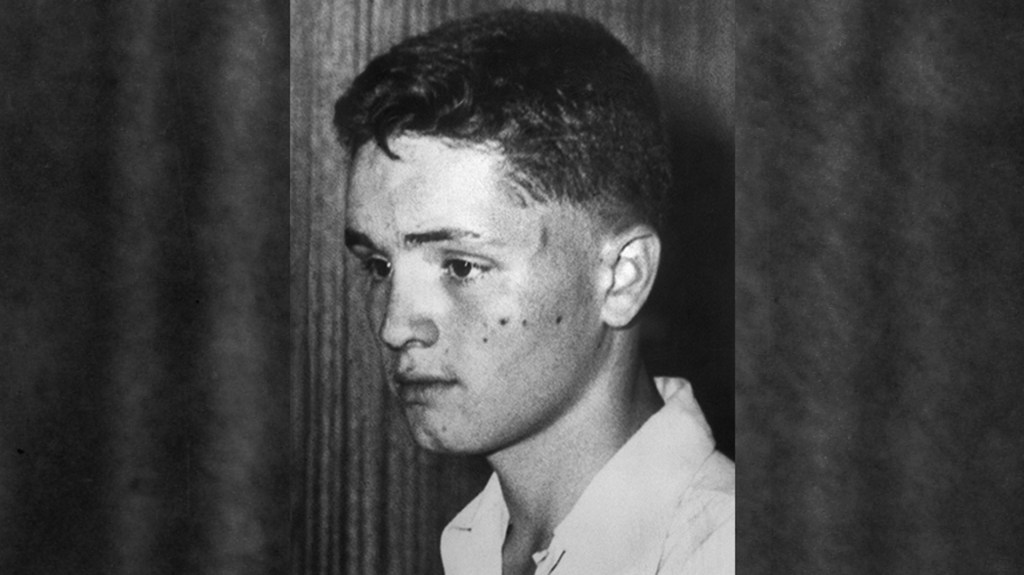
Here we have Charles Manson as a pimply, dimpled fourteen year old. The dreamy Elvis look in his eyes belies the adult cult following that would come thirty years later. Image from A&E
In this post I’m going to discuss two positive leadership traits of Manson, and the big flaw that brought him down in my humble opinion.
1) Say what you will, the man had a vision and was able to get people to follow that vision.
2) Charles Manson was persistent, and persevered in the face of adversity.
3) Unfortunately, in the end Manson failed to exhibit the self confidence needed to truly overcome the adversity he faced.
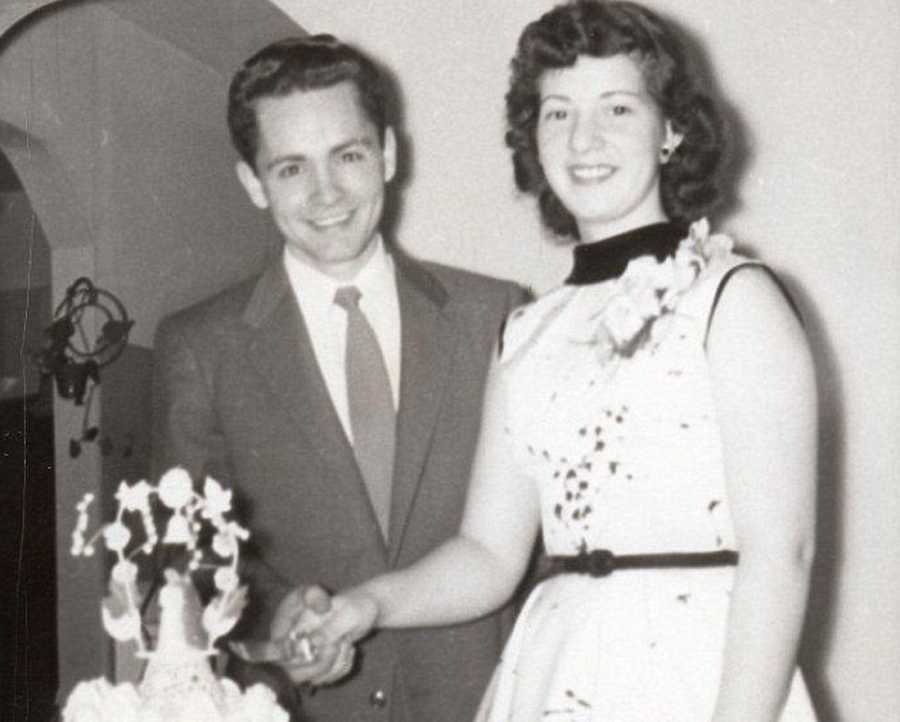
A happy 21 year old Charles Manson, fresh out of prison and with high hopes of a better life, marries waitress Rosalie Willis. The marriage lasted three years, Rosalie filed for divorce when Charles landed in jail while she was pregnant. Image from purpleclover.com.
Why is it that we remember Charles Manson when so many crimes from the sixties have been forgotten? Part of it, of course, is the fame of the victims. That he targeted the rich elites and not merely the poor of the streets. All the drugs and sex and rock & roll made it glamorous. But I think another part of the mythos is the fact that Manson had a vision. It was a crazed, warped, wtf vision. But he had a vision.
Yes….we knew Manson was a cult leader and serial killer…but here we see he was also a litter bug! I was willing to forgive him before, but this is just too much! Damn him to hell! Image from radaronline.com
Charles Manson’s vision was that there was about to be a race/civil war in the US, and the blacks would win. While this didn’t happen, looking at all the riots at the end of the sixties, the idea may not have seemed so far fetched. And while the blacks were (are) oppressed, it could be argued that that very oppression might be their advantage. Well armed blacks toughened by hard labor in a war against soft white collar whites….Ceteris paribus I know which side my money is on. But we were spared, if only for a time.
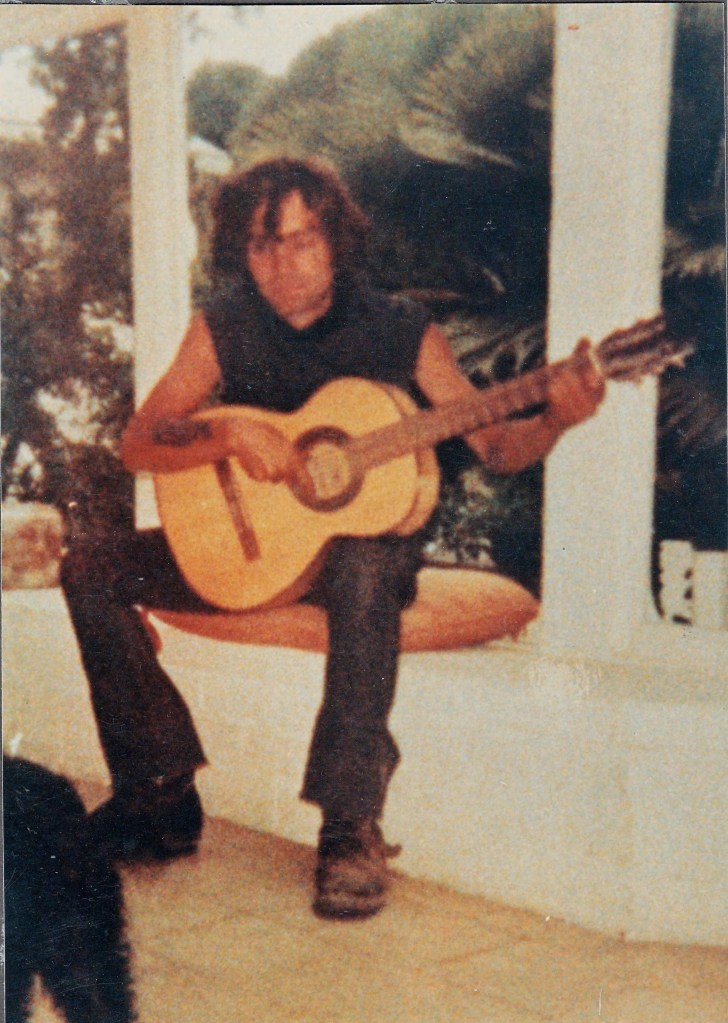
Rare image of Charles Manson at Dennis Wilson’s house. Likely he is singing “Good Vibrations.” Possibly “I Wish They All Could be California Girls.” Image from Reddit.
“Ok Tired Blogger, of course, he had a twisted vision. But what do you mean he persisted against adversity? He caved like a scared rabbit when the police arrested him! Plus according to the Youtube documentary, he was “scared shitless” when he shot a member of the Black Panthers and thought he’d killed him. Some believe that is when he panicked and started making real mistakes.”
Point taken. But hear me out…imagine the little boy pictured above. His tough uncle is yelling at him for being a weakling and sissy. He tells him he needs the “old-time religion” to “honor his father and mother.” The uncle drags the boy kicking and screaming, to an edifice that looks like one of Sauron’s dungeons.
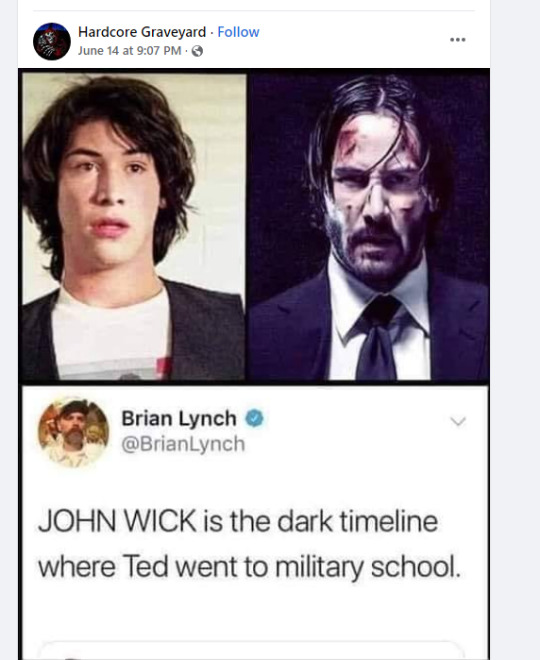
McMechen prison, where Charles Manson’s mother Kathleen Maddox was incarcerated through several years of his childhood. Originally used as a Civil War prison camp, this somber house of horrors had to have some influence on how the boy’s mind was shaped. Image and info from https://lostandabandonedam.wixsite.com/laaa/west-virginia-state-penitentaryYa didn’t think I’d let a post go by without some snarky meme or other did ya? Only in Charles Manson’s timeline, maybe he would have become Neo….the world will never know.
Twice he escaped from this school. The first time he returned to his mother, who just sent him back. The second time, he set out on his own. But he kept true to two of his dreams through the fifties and into the sixties. He dreamt of reconnecting with his mother. He visited her multiple times, the last time was in the sixties when he had already gathered his own cult following. And he remained true to his dream of being a pimp, becoming perhaps the ultimate pimp. His manipulative, hypnotic influence caused broken young women to not only sleep with men for money, drugs, or to seduce them into his web of deceit, but also he had the ability to order them to murder without feeling a twinge of guilt. Between his girls, his theft, and possible CIA provisions of free drugs, he was able to manage a cult of up to a hundred people for two years in the burgeoning hippy scene.
How’s that for leadership?
And let’s not forget, he managed to survive till he was 83 in prison. For all those that say he was weak (and yeah, in a lot of ways he was) I don’t think I’d make it till 83 if I went to prison.
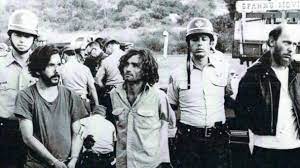
Charles Manson and followers arrested for the famous Tate murders. Image from abcnews.go.com
“Ok Tired Blogger, he was a great leader. But he spent the last fifty years of his life in prison. What was his tragic flaw?”
I’m so glad you asked. His tragic flaw was cowardice. I can hear most of you now, saying it was his lack of empathy or his massive hubris or the fact that he was literally psychotic. And likely these things played a role. But with his tenacity, I think he could have overcome all of that if he hadn’t been such a coward.
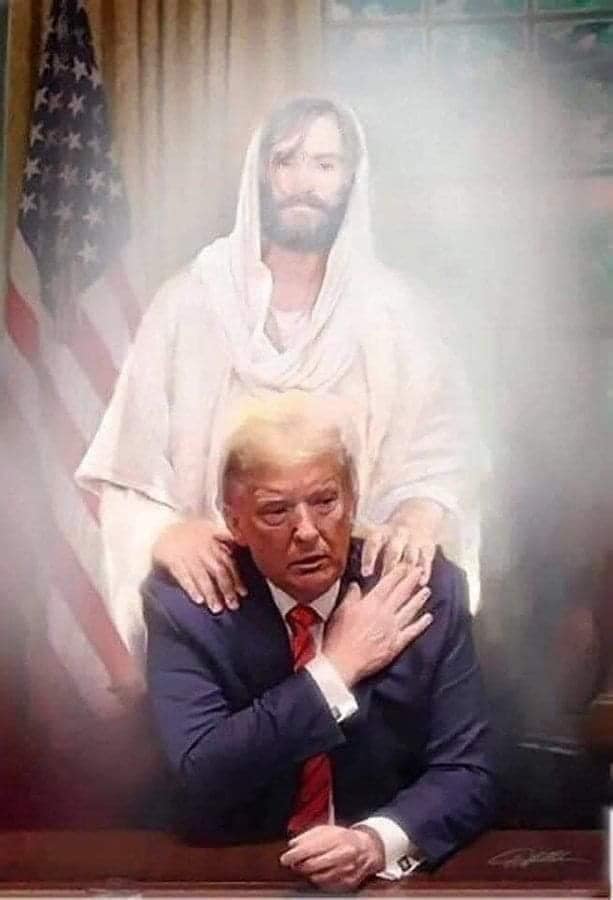
I used to feel disgusted by this image…but according to Twitter (and nobody on Twitter would ever lie), this is not Jesus hugging Trump. It is the ghost of Charles Manson. Who is it really supposed to be? Either way, it is a frightening image to me. If anyone can lead me to the truth of it, please leave comments.
It was fear of someone stronger that led him to succumb to his threatening fundamentalist relatives when he should have pursued music. It was fear of rejection by a woman (just like his mother) that led him to desire to be a pimp instead of being a good husband and lover to his wife. It was fear of the blacks and of the chaos of the late sixties that led him to his terrible vision. It was fear of the Black Panthers that led him to panic and decide he had to commit murders and pin them on the Panthers. In the end, he was too much of a coward to do the killings himself.
In the end, I think most of us have loathsome, disgusting qualities that scare us. Thoughts, feelings, habits, tendencies. My Criminal Profiling professor claimed we are all more alike than we are different. And as repelled as most of us are (and deservedly so) by serial killers and cult figures, I think more of us than would like to admit feel a connection to the dark side. No….we couldn’t do what Manson did. Most of us would vomit to see a dead body. Most of us are disgusted by pimps and manipulative narcissists. But yet we watch crime shows, cop shows, the CSI franchise is such a juggernaut they might as well partner with the Marvel Cinematic Universe and take over the world.
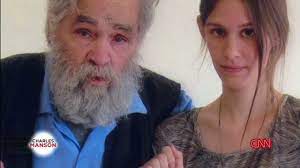
Charles Manson nearing the end, posing with his fiancée. I don’t know….I think she just thought angry Swastika Santa was hot. Image from the NY Post.
Since he loved music, I think a musical tribute to him would be fitting:
A lonely child/ alone and wild/ a conman’s wanton son/his hands were meant for gruesome work and his heart was known to none/ He left his mom and went his lone and solitary way/ He gave Hollywood/ Terror when his women did obey
Complaining child of music/denied a simpler fate/ He tried to be a pander once/ But the prison wouldn’t wait/ He earned his love through LSD, a madman’s foolish scam/ His wicked means of sculpting souls we’ll never understand.
The leader of the band has died and his lies are so damned old, but the blood used as an instrument/ made us scream within our souls/ My blog has made a poor attempt to illustrate the man/ We are the living legacy to the leader of the band…
You don’t think our leaders learned their trade from Manson? Just ask this guy…..oh wait…we can’t because he is dead. Well, nothing to see here citizen, move along.
I’ll admit I’ve only listened to a few of his songs. For my money, this is the best that I have listened to. You’d never know if you didn’t know, that this was Manson. “Look down at me and you see a fool, look up at me and you see a god, look straight at me and you see yourself.”




 Tired Midnight Blogger (What Blogs at Midnight)